Sunday, September 14, 2025

APOD - Planets of the Solar System: Tilts and Spins

Astronomy Picture of the Day

Discover the cosmos! Each day a different image or photograph of our fascinating universe is featured, along with a brief explanation written by a professional astronomer.

2025 September 14
https://www.youtube.com/embed/my1euFQHH-o?rel=0


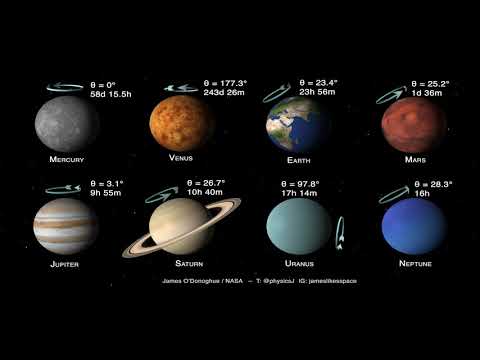
Planets of the Solar System: Tilts and Spins
Video Credit: NASA, Animation: James O'Donoghue (U. Reading)

Explanation: How does your favorite planet spin? Does it spin rapidly around a nearly vertical axis, or horizontally, or backwards? The featured video animates NASA images of all eight planets in our Solar System to show them spinning side-by-side for an easy comparison. In the time-lapse video, a day on Earth -- one Earth rotation -- takes just a few seconds. Jupiter rotates the fastest, while Venus spins not only the slowest (can you see it?), but backwards. The inner rocky planets across the top underwent dramatic spin-altering collisions during the early days of the Solar System. Why planets spin and tilt as they do remains a topic of research with much insight gained from modern computer modeling and the recent discovery and analysis of hundreds of exoplanets: planets orbiting other stars.

Tomorrow's picture: sun belch


< | Archive | Submissions | Index | Search | Calendar | RSS | Education | About APOD | Discuss | >

Authors & editors: Robert Nemiroff (MTU) & Jerry Bonnell (UMCP)
NASA Official: Amber Straughn Specific rights apply.
NASA Web Privacy, Accessibility, Notices;
A service of: ASD at NASA / GSFC,
NASA Science Activation
& Michigan Tech. U.


This is an automated email. If you notice any problems, just send me a note at gtracy@gmail.com. You can add and remove email addresses to this distribution list here, https://apodemail.org.Unsubscribe

Saturday, September 13, 2025

APOD - Star Trails over One-Mile Radio Telescope

Astronomy Picture of the Day

Discover the cosmos! Each day a different image or photograph of our fascinating universe is featured, along with a brief explanation written by a professional astronomer.

2025 September 13
See Explanation.  Clicking on the picture will download  the highest resolution version available.

Star Trails over One-Mile Radio Telescope
Image Credit & Copyright: Joao Yordanov Serralheiro

Explanation: The steerable 60 foot diameter dish antenna of the One-Mile Telescope at Mullard Radio Astronomy Observatory, Cambridge, UK, is pointing skyward in this evocative night-skyscape. To capture the dramatic scene, consecutive 30 second exposures were recorded over a period of 90 minutes. Combined, the exposures reveal a background of gracefully arcing star trails that reflect planet Earth's daily rotation on its axis. The North Celestial Pole, the extension of Earth's axis of rotation into space, points near Polaris, the North Star. That's the bright star that creates the short trail near the center of the concentric arcs. But the historic One-Mile Telescope array also relied on planet Earth's rotation to operate. Exploring the universe at radio wavelengths, it was the first radio telescope to use Earth-rotation aperture synthesis. That technique uses the rotation of the Earth to change the relative orientation of the telescope array and celestial radio sources to create radio maps of the sky at a resolution better than that of the human eye.

Tomorrow's picture: tilts and spins


< | Archive | Submissions | Index | Search | Calendar | RSS | Education | About APOD | Discuss | >

Authors & editors: Robert Nemiroff (MTU) & Jerry Bonnell (UMCP)
NASA Official: Amber Straughn Specific rights apply.
NASA Web Privacy, Accessibility, Notices;
A service of: ASD at NASA / GSFC,
NASA Science Activation
& Michigan Tech. U.


This is an automated email. If you notice any problems, just send me a note at gtracy@gmail.com. You can add and remove email addresses to this distribution list here, https://apodemail.org.Unsubscribe