Astronomy Picture of the Day
Discover the cosmos! Each day a different image or photograph of our fascinating universe is featured, along with a brief explanation written by a professional astronomer.
2023 February 26
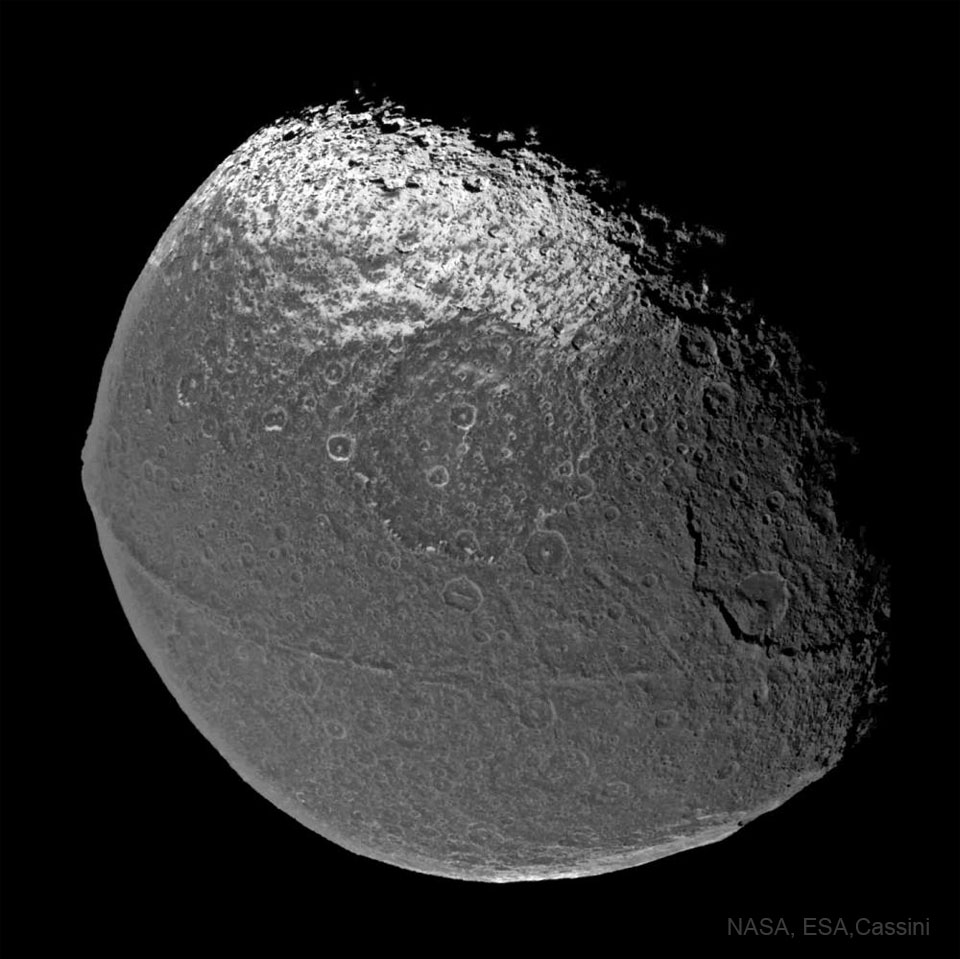
Saturn's Iapetus: Moon with a Strange Surface
Image Credit: NASA, ESA, JPL, SSI, Cassini Imaging Team Explanation: What would make a moon look like a walnut? A strange ridge that circles Saturn's moon Iapetus's equator, visible near the bottom of the featured image, makes it appear similar to a popular edible nut. The origin of the ridge remains unknown, though, with hypotheses including ice that welled up from below, a ring that crashed down from above, and structure left over from its formation perhaps 100 million years ago. Also strange is that about half of Iapetus is so dark that it can nearly disappear when viewed from Earth, while the rest is, reflectively, quite bright. Observations show that the degree of darkness of the terrain is strangely uniform, as if a dark coating was somehow recently applied to an ancient and highly cratered surface. Last, several large impact basins occur around Iapetus, with a 400-kilometer wide crater visible near the image center, surrounded by deep cliffs that drop sharply to the crater floor. The featured image was taken by the Saturn-orbiting Cassini spacecraft during a flyby of Iapetus at the end of 2004.
Tomorrow's picture: dawn before dawn
< | Archive | Submissions | Index | Search | Calendar | RSS | Education | About APOD | Discuss | >
Authors & editors: Robert Nemiroff (MTU) & Jerry Bonnell (UMCP)
NASA Official: Phillip Newman Specific rights apply.
NASA Web Privacy Policy and Important Notices
A service of: ASD at NASA / GSFC,
NASA Science Activation
& Michigan Tech. U.
This is an automated email. If you notice any problems, just send me a note at gtracy@gmail.com. You can add and remove email addresses to this distribution list here, https://apodemail.org.Unsubscribe