Tuesday, March 29, 2022

APOD - Venus and Mars: Passing in the Night

Astronomy Picture of the Day

Discover the cosmos! Each day a different image or photograph of our fascinating universe is featured, along with a brief explanation written by a professional astronomer.

2022 March 29

An image of the sky over a Brazil featuring the bright   planets Venus and Mars near to each other on the sky.   Please see the explanation for more detailed information.

Venus and Mars: Passing in the Night
Image Credit & Copyright: Carlos Kiko Fairbairn

Explanation: When two planets pass on the night sky, they can usually be seen near each other for a week or more. In the case of this planetary conjunction, Venus and Mars passed within 4 degrees of each other earlier this month. The featured image was taken a few days prior, when Venus was slowing rising in the pre-dawn sky, night by night, while Mars was slowly setting. The image, a four-part mosaic, was captured in Brazil from the small town Teresópolis. Besides Venus and Mars, the morning sky now also includes the more distant planet Saturn. Of course, these conjunctions are only angular -- Venus, Mars, and Saturn continue to orbit the Sun in very different parts of our Solar System. Next week, the angle between Saturn and Mars will drop to below a quarter of a degree.

Tomorrow's picture: rings unknown


< | Archive | Submissions | Index | Search | Calendar | RSS | Education | About APOD | Discuss | >

Authors & editors: Robert Nemiroff (MTU) & Jerry Bonnell (UMCP)
NASA Official: Phillip Newman Specific rights apply.
NASA Web Privacy Policy and Important Notices
A service of: ASD at NASA / GSFC
& Michigan Tech. U.


This is an automated email. If you notice any problems, just send me a note at gtracy@gmail.com. You can add and remove email addresses to this distribution list here, https://apodemail.org.Unsubscribe

Monday, March 28, 2022

APOD - Gems of a Maldivean Night

Astronomy Picture of the Day

Discover the cosmos! Each day a different image or photograph of our fascinating universe is featured, along with a brief explanation written by a professional astronomer.

2022 March 28
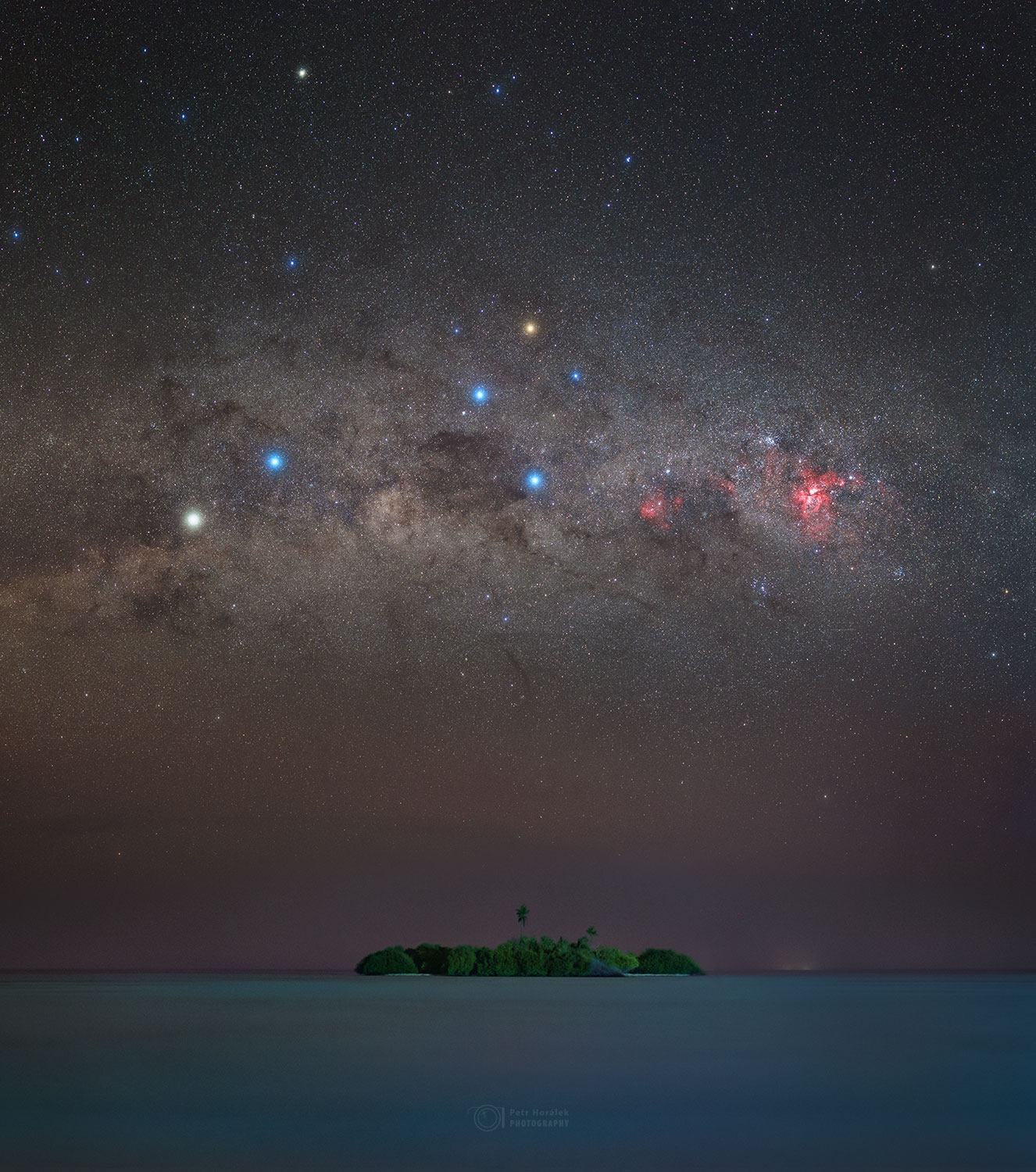
An image of the sky over a small island in the Maldives.  The dark sky contains the Southern Cross and the stars Alpha  Centauri and Hadar.   Please see the explanation for more detailed information.

Gems of a Maldivean Night
Image Credit & Copyright: Petr Horálek (ESO Photo Ambassador, Inst. of Physics in Opava)

Explanation: The southernmost part of the Milky Way contains not only the stars of the Southern Cross, but the closest star system to our Sun -- Alpha Centauri. The Southern Cross itself is topped by the bright, yellowish star Gamma Crucis. A line from Gamma Crucis through the blue star at the bottom of the cross, Acrux, points toward the south celestial pole, located just above the small island in the featured picture -- taken in early March. That island is Madivaru of the Maldives in the Indian Ocean. Against faint Milky Way starlight, the dark Coal Sack Nebula lies just left of the cross, while farther left along the Milky Way are the bright stars Alpha Centauri (left) and Beta Centauri (Hadar). Alpha Centauri A, a Sun-like star anchoring a three-star system with exoplanets, is a mere 4.3 light-years distant. Seen from Alpha Centauri, our own Sun would be a bright yellowish star in the otherwise recognizable constellation Cassiopeia.

Almost Hyperspace: Random APOD Generator
Tomorrow's picture: planet planet


< | Archive | Submissions | Index | Search | Calendar | RSS | Education | About APOD | Discuss | >

Authors & editors: Robert Nemiroff (MTU) & Jerry Bonnell (UMCP)
NASA Official: Phillip Newman Specific rights apply.
NASA Web Privacy Policy and Important Notices
A service of: ASD at NASA / GSFC
& Michigan Tech. U.


This is an automated email. If you notice any problems, just send me a note at gtracy@gmail.com. You can add and remove email addresses to this distribution list here, https://apodemail.org.Unsubscribe