Friday, July 4, 2025

APOD - NGC 6946 and NGC 6939

Astronomy Picture of the Day

Discover the cosmos! Each day a different image or photograph of our fascinating universe is featured, along with a brief explanation written by a professional astronomer.

2025 July 4
See Explanation.  Clicking on the picture will download  the highest resolution version available.

NGC 6946 and NGC 6939
Image Credit & Copyright: Alberto Pisabarro

Explanation: Face-on spiral galaxy NGC 6946 and open star cluster NGC 6939 share this cosmic snapshot, composed with over 68 hours of image data captured with a small telescope on planet Earth. The field of view spans spans about 1 degree or 2 full moons on the sky toward the northern constellation Cepheus. Seen through faint interstellar dust clouds near the plane of our Milky Way galaxy, the stars of open cluster NGC 6939 are 5,600 light-years in the distance, near bottom right in the frame. Face-on spiral galaxy NGC 6946 is at top left, but lies some 22 million light-years away. In the last 100 years, 10 supernovae have been discovered in NGC 6946, the latest one seen in 2017. By comparison, the average rate of supernovae in our Milky Way is about 1 every 100 years or so. Of course, NGC 6946 is also known as The Fireworks Galaxy.

Tomorrow's picture: squid game


< | Archive | Submissions | Index | Search | Calendar | RSS | Education | About APOD | Discuss | >

Authors & editors: Robert Nemiroff (MTU) & Jerry Bonnell (UMCP)
NASA Official: Amber Straughn Specific rights apply.
NASA Web Privacy, Accessibility, Notices;
A service of: ASD at NASA / GSFC,
NASA Science Activation
& Michigan Tech. U.


This is an automated email. If you notice any problems, just send me a note at gtracy@gmail.com. You can add and remove email addresses to this distribution list here, https://apodemail.org.Unsubscribe
Thursday, July 3, 2025

APOD - Nova V462 Lupi Now Visible

Astronomy Picture of the Day

Discover the cosmos! Each day a different image or photograph of our fascinating universe is featured, along with a brief explanation written by a professional astronomer.

2025 July 3
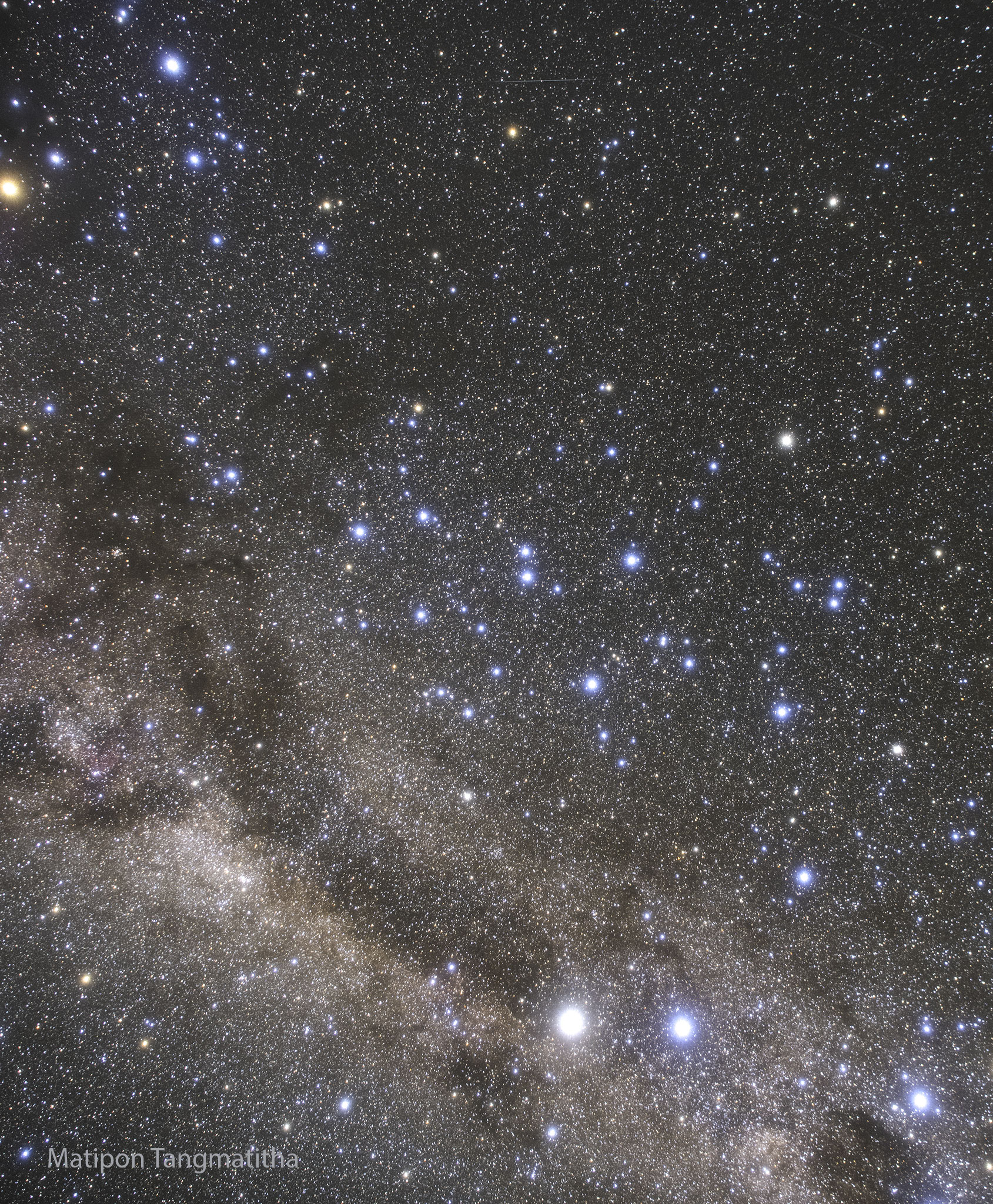
A starfield is shown with constellations annotated. The band  of our Milky Way galaxy runs diagonally from the upper left to the   lower right. Just above the image center is a faint dot that is  annotated in yellow -- V462 LUPI, a nova that was visible with  the unaided eye last week and is currently still   visible with binoculars.   Please see the explanation for more detailed information.

Nova V462 Lupi Now Visible
Image Credit & Copyright: Matipon Tangmatitham (NARIT)

Explanation: If you know where to look, you can see a thermonuclear explosion from a white dwarf star. Possibly two. Such explosions are known as novas and the detonations are currently faintly visible with the unaided eye in Earth's southern hemisphere -- but are more easily seen with binoculars. Pictured, Nova Lupi 2025 (V462 Lupi) was captured toward the southern constellation of the Wolf (Lupus) last week near the central plane of our Milky Way galaxy. Nova Lupi 2025 was originally discovered on June 12 and peaked in brightness about a week later. Similarly, Nova Velorum 2025, toward the southern constellation of the Ship Sails (Vela), was discovered on June 25 and peaked a few days later. A nova somewhere in our Galaxy becomes briefly visible to the unaided eye only every year or two, so it is quite unusual to have two novas visible simultaneously. Meanwhile, humanity awaits even a different nova: T Coronae Borealis, which should become visible in northern skies and is expected to become even brighter.

Tomorrow's picture: open space


< | Archive | Submissions | Index | Search | Calendar | RSS | Education | About APOD | Discuss | >

Authors & editors: Robert Nemiroff (MTU) & Jerry Bonnell (UMCP)
NASA Official: Amber Straughn Specific rights apply.
NASA Web Privacy, Accessibility, Notices;
A service of: ASD at NASA / GSFC,
NASA Science Activation
& Michigan Tech. U.


This is an automated email. If you notice any problems, just send me a note at gtracy@gmail.com. You can add and remove email addresses to this distribution list here, https://apodemail.org.Unsubscribe