Sunday, October 6, 2024

APOD - The Magnificent Tail of Comet McNaught

Astronomy Picture of the Day

Discover the cosmos! Each day a different image or photograph of our fascinating universe is featured, along with a brief explanation written by a professional astronomer.

2024 October 6
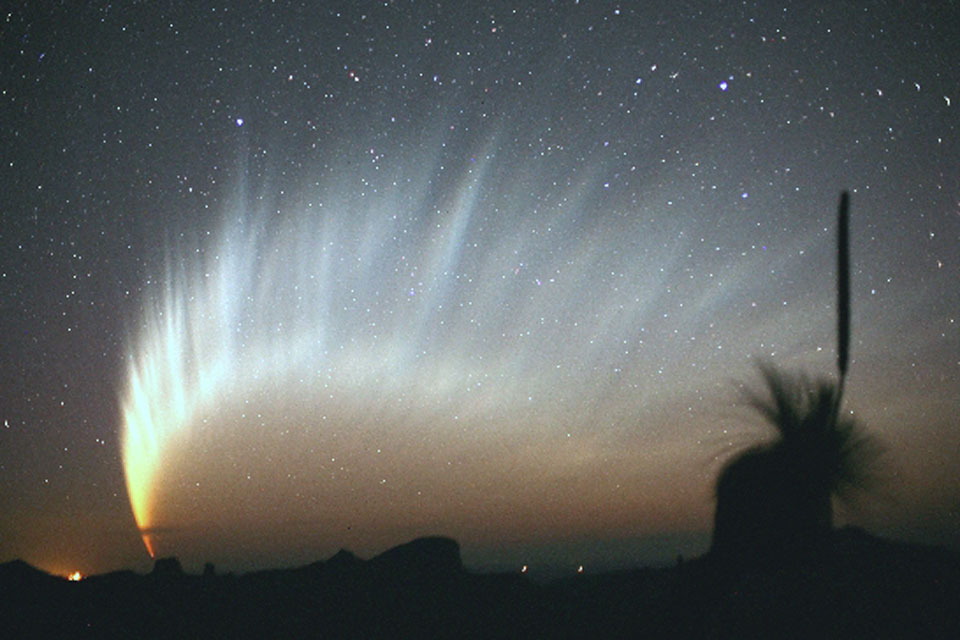
A starry sky is pictured just after sunset. The silhouette  of plants and a distant landscape covers the bottom of the  picture. Spanning most of the frame is a comet with an  amazingly long and complex tail.   Please see the explanation for more detailed information.

The Magnificent Tail of Comet McNaught
Image Credit & Copyright: Robert H. McNaught

Explanation: Comet McNaught, the Great Comet of 2007, grew a spectacularly long and filamentary tail. The magnificent tail spread across the sky and was visible for several days to Southern Hemisphere observers just after sunset. The amazing ion tail showed its greatest extent on long-duration, wide-angle camera exposures. During some times, just the tail itself was visible just above the horizon for many northern observers as well. Comet C/2006 P1 (McNaught), estimated to have attained a peak brightness of magnitude -5 (minus five), was caught by the comet's discoverer in the featured image just after sunset in January 2007 from Siding Spring Observatory in Australia. Comet McNaught, the brightest comet in decades, then faded as it moved further into southern skies and away from the Sun and Earth. Over the next month, Comet Tsuchinshan–ATLAS, a candidate for the Great Comet of 2024, should display its most spectacular tails visible from the Earth.

Tomorrow's picture: another tall tail


< | Archive | Submissions | Index | Search | Calendar | RSS | Education | About APOD | Discuss | >

Authors & editors: Robert Nemiroff (MTU) & Jerry Bonnell (UMCP)
NASA Official: Amber Straughn Specific rights apply.
NASA Web Privacy, Accessibility, Notices;
A service of: ASD at NASA / GSFC,
NASA Science Activation
& Michigan Tech. U.


This is an automated email. If you notice any problems, just send me a note at gtracy@gmail.com. You can add and remove email addresses to this distribution list here, https://apodemail.org.Unsubscribe

Saturday, October 5, 2024

APOD - M27: Not a Comet

Astronomy Picture of the Day

Discover the cosmos! Each day a different image or photograph of our fascinating universe is featured, along with a brief explanation written by a professional astronomer.

2024 October 5
See Explanation.  Clicking on the picture will download  the highest resolution version available.

M27: Not a Comet
Image Credit & Copyright: Francesco Sferlazza, Franco Sgueglia

Explanation: While hunting for comets in the skies above 18th century France, astronomer Charles Messier diligently kept a list of the things encountered during his telescopic expeditions that were definitely not comets. This is number 27 on his now famous not-a-comet list. In fact, 21st century astronomers would identify it as a planetary nebula, but it's not a planet either, even though it may appear round and planet-like in a small telescope. Messier 27 (M27) is an excellent example of a gaseous emission nebula created as a sun-like star runs out of nuclear fuel in its core. The nebula forms as the star's outer layers are expelled into space, with a visible glow generated by atoms excited by the dying star's intense but invisible ultraviolet light. Known by the popular name of the Dumbbell Nebula, the beautifully symmetric interstellar gas cloud is over 2.5 light-years across and about 1,200 light-years away in the constellation Vulpecula. This impressive color image highlights details within the well-studied central region and fainter, seldom imaged features in the nebula's outer halo.

Tomorrow's picture: a comet's tale


< | Archive | Submissions | Index | Search | Calendar | RSS | Education | About APOD | Discuss | >

Authors & editors: Robert Nemiroff (MTU) & Jerry Bonnell (UMCP)
NASA Official: Phillip Newman Specific rights apply.
NASA Web Privacy Policy and Important Notices
A service of: ASD at NASA / GSFC,
NASA Science Activation
& Michigan Tech. U.


This is an automated email. If you notice any problems, just send me a note at gtracy@gmail.com. You can add and remove email addresses to this distribution list here, https://apodemail.org.Unsubscribe