Tuesday, March 1, 2022

APOD - Dueling Bands in the Night

Astronomy Picture of the Day

Discover the cosmos! Each day a different image or photograph of our fascinating universe is featured, along with a brief explanation written by a professional astronomer.

2022 March 1
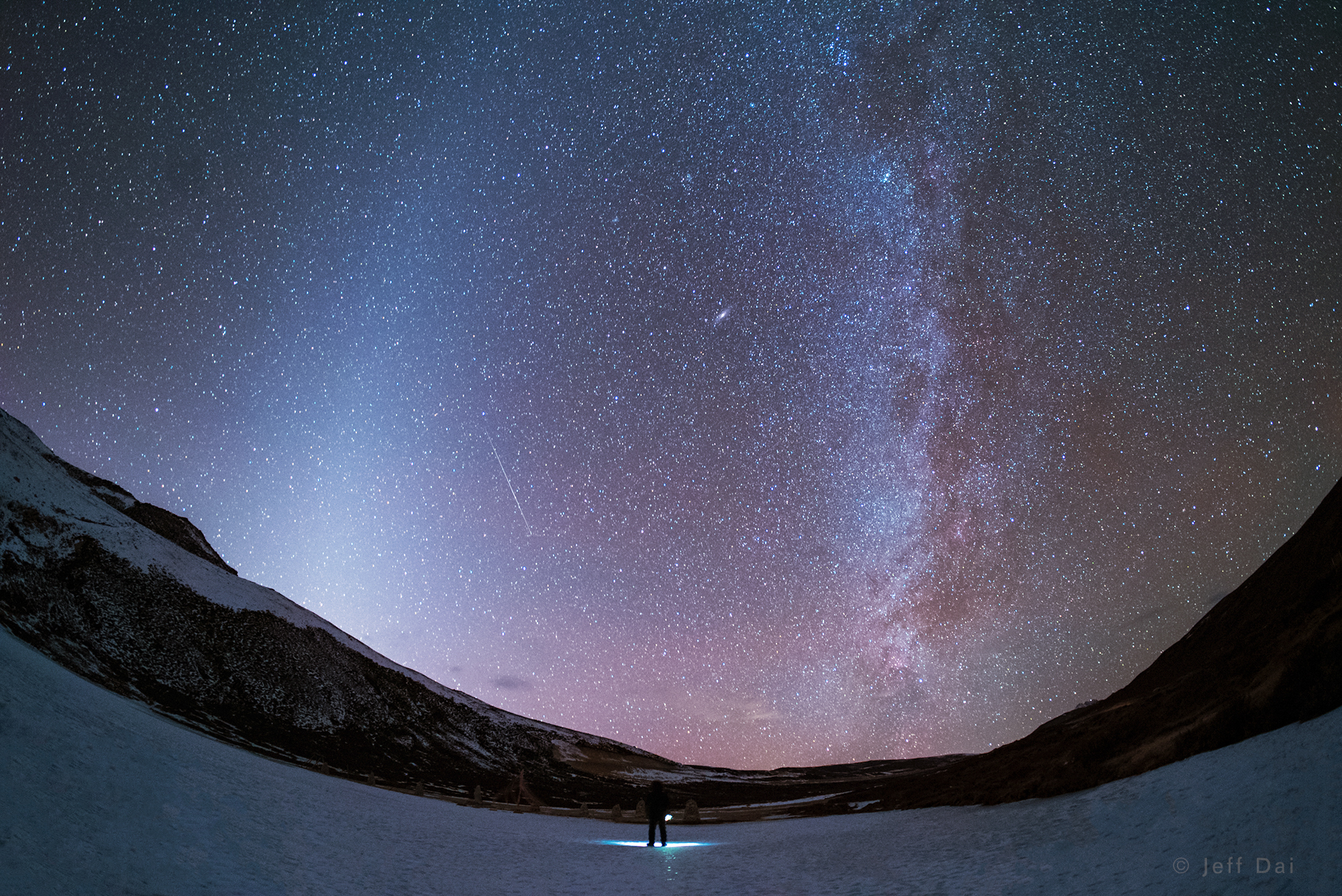
The featured image shows a nightscape over China  featuring bands of zodiacal light, on the left, and the central  band of our Milky Way Galaxy, on the right.  Please see the explanation for more detailed information.

Dueling Bands in the Night
Image Credit & Copyright: Jeff Dai (TWAN)

Explanation: What are these two bands in the sky? The more commonly seen band is the one on the right and is the central band of our Milky Way galaxy. Our Sun orbits in the disk of this spiral galaxy, so that from inside, this disk appears as a band of comparable brightness all the way around the sky. The Milky Way band can also be seen all year -- if out away from city lights. The less commonly seem band, on the left, is zodiacal light -- sunlight reflected from dust orbiting the Sun in our Solar System. Zodiacal light is brightest near the Sun and so is best seen just before sunrise or just after sunset. On some evenings in the north, particularly during the months of March and April, this ribbon of zodiacal light can appear quite prominent after sunset. It was determined only this century that zodiacal dust was mostly expelled by comets that have passed near Jupiter. Only on certain times of the year will the two bands be seen side by side, in parts of the sky, like this. The featured image, including the Andromeda galaxy and a meteor, was captured in late January over a frozen lake in Kanding, Sichuan, China.

Tomorrow's picture: it came from the sun


< | Archive | Submissions | Index | Search | Calendar | RSS | Education | About APOD | Discuss | >

Authors & editors: Robert Nemiroff (MTU) & Jerry Bonnell (UMCP)
NASA Official: Phillip Newman Specific rights apply.
NASA Web Privacy Policy and Important Notices
A service of: ASD at NASA / GSFC
& Michigan Tech. U.


This is an automated email. If you notice any problems, just send me a note at gtracy@gmail.com. You can add and remove email addresses to this distribution list here, https://apodemail.org.Unsubscribe

Monday, February 28, 2022

APOD - Direct Projection: The Moon in My Hands

Astronomy Picture of the Day

Discover the cosmos! Each day a different image or photograph of our fascinating universe is featured, along with a brief explanation written by a professional astronomer.

2022 February 28
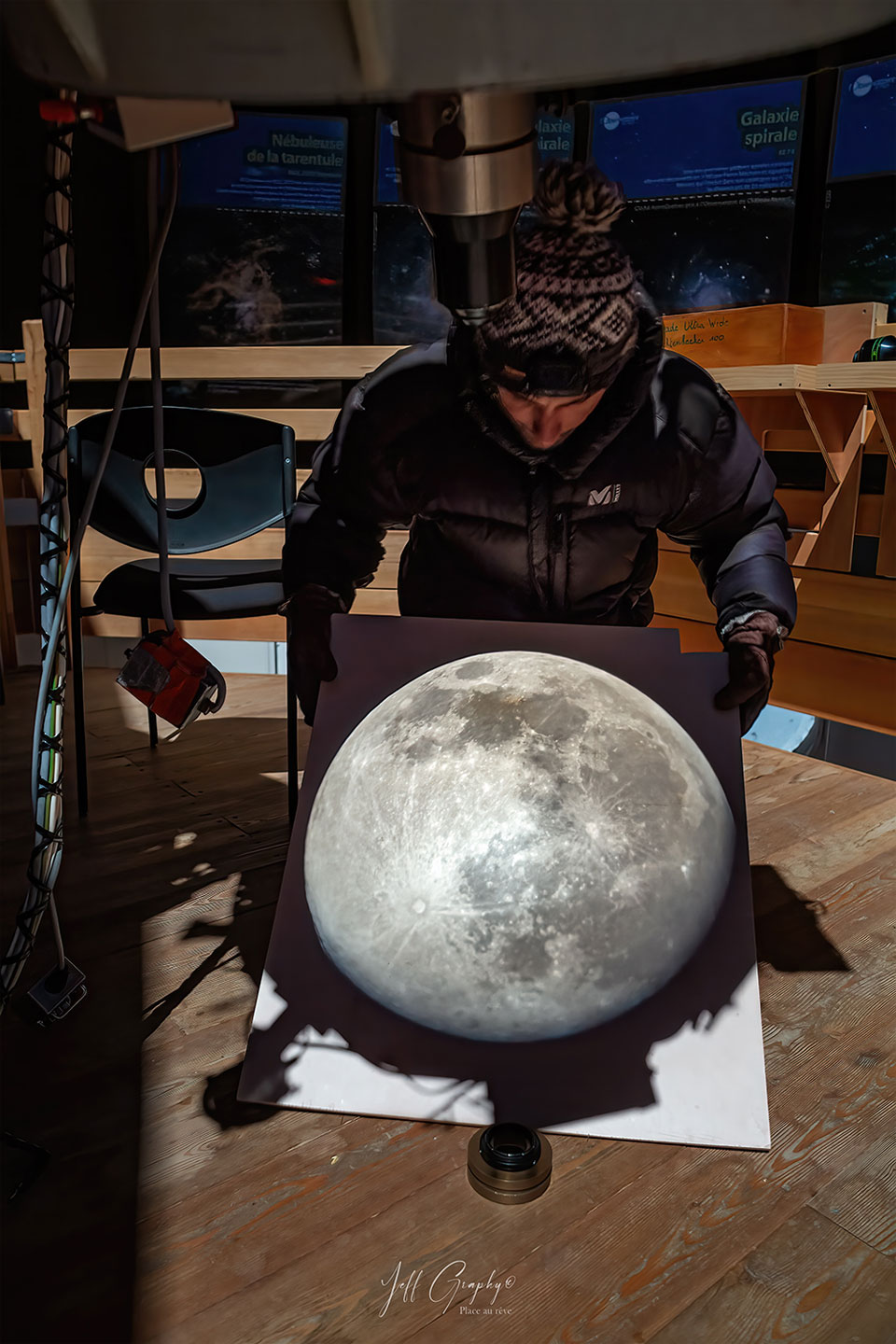
The featured image shows a direction projection of the last   full moon through the optics of a mid-sized telescope high in   the French Alps.   Please see the explanation for more detailed information.

Direct Projection: The Moon in My Hands
Image Credit & Copyright: Jeff Graphy

Explanation: You don't have to look through a telescope to know where it's pointing. Allowing the telescope to project its image onto a large surface can be useful because it dilutes the intense brightness of very bright sources. Such dilution is useful for looking at the Sun, for example during a solar eclipse. In the featured single-exposure image, though, it is a too-bright full moon that is projected. This February full moon occurred two weeks ago and is called the Snow Moon by some northern cultures. The projecting instrument is the main 62-centimeter telescope at the Saint-Véran Observatory high in the French Alps. Seeing a full moon directly is easier because it is not too bright, although you won't see this level of detail. Your next chance will occur on March 17.

Tomorrow's picture: dueling bands


< | Archive | Submissions | Index | Search | Calendar | RSS | Education | About APOD | Discuss | >

Authors & editors: Robert Nemiroff (MTU) & Jerry Bonnell (UMCP)
NASA Official: Phillip Newman Specific rights apply.
NASA Web Privacy Policy and Important Notices
A service of: ASD at NASA / GSFC
& Michigan Tech. U.


This is an automated email. If you notice any problems, just send me a note at gtracy@gmail.com. You can add and remove email addresses to this distribution list here, https://apodemail.org.Unsubscribe